
5801 W 44th Ave Unit C, Denver, CO 80212, United States

Frequently Asked Dental Implant Questions
Posted On December 27, 2018
Are dental implants worth it?
The cost, the pain, the long process of having them placed? Yes, they are worth it. Usually. The benefits of having a dental implant replace a missing tooth or teeth almost always outweigh the risks. Many factors must be taken into consideration when you need to replace a missing tooth or teeth. To date, dental implants offer one of the best solutions to replace missing teeth. Your dentist will be able to go over all of the pros and cons with you and answer any questions you may have.
When are dental implants needed?
Most dental professionals would agree that replacing a missing tooth or teeth with dental implant-supported crowns or bridges is the way to go. A dental implant does not rely on neighboring teeth to support a fixed or removable bridge. A dental implant is like an artificial tooth root implanted into the jawbone. Because an implant transmits the forces of chewing down into the jawbone the same as a natural tooth does, preservation of the bone volume in that area is usually good with an implant. Having a replacement tooth in the space created by a missing tooth also prevents adjacent teeth from shifting into that space.
If you have one or more missing teeth, an implant is usually the best option for addressing the issue with a long-term solution.
Are dental implants permanent?
A dental implant is meant to be a permanent solution to a missing tooth or teeth. And with proper care, it can be! Factors that affect how long dental implants last depend largely on the patient’s lifestyle and dental hygiene. Pre-existing medical conditions, diseases, and patient misuse are the most likely factors that cause an implant to fail. Dental technology has become so advanced over the years that implant failures due to rejection or function issues are largely a problem of the past.
So just how long will a dental implant last?
When properly maintained with proper brushing and flossing as well as regular visits to the dentist, an implant can last a lifetime.
Can dental implants fail?
As mentioned above, an implant can last a lifetime. However, several factors can cause an implant to fail prematurely. People with pre-existing medical conditions such as diabetes or cancer have a higher risk of dental implant failure. Location in the mouth can also contribute to failure. The back molars, for example, receive more strain from chewing than the front teeth do, which could cause a premature failure. Like real teeth, good oral hygiene is a must for a dental implant to last a long time.
Are dental implants safe for diabetics?
If you suffer from diabetes, you are not barred from having dental implants; however, you should be aware that you are at a greater risk for implant complications as compared to others. This is because people suffering from Type 1 or Type 2 diabetes usually take a longer time to heal the wound of the surgical implant. Diabetic patients are also at a greater risk of infection. However, advancements and new research in dental implant procedures are showing that diabetic patients have a higher rate of success than previously thought if their healing stage is accommodated.
Can dental implants be removed?
Yes, it is possible to remove a dental implant. Given the right circumstances and tools, removing an implant can be easier than placing one in the mouth.
Are dental implants painful?
Some discomfort is to be expected after an implant surgery. Although discomfort varies from person to person, most patients report that there was much less pain than they expected. There are a few things that can predict the level of discomfort you can expect. The first is the ease or difficulty of your unique situation, or in other words, how involved the procedure was and how many implants were placed. The second is your body’s ability to heal and the third is the skill and training of your implant dentist.
When will dental implants stop hurting?
The dentist will most likely prescribe pain medication to help with the post-op pain. Typically, you can expect some pain/tenderness for up to a week to 10 days. There will also likely be swelling, and that should subside after 3-5 days.
Pain should not be a major factor in your choosing to get an implant or not. You should choose the treatment that will give you the best outcome possible.
Can dental implants cause bad breath?
Yes. There is one potential downside to an implant, and that is bad breath. The good news is that this is fixable! In almost all cases, this situation is caused by an infection. The beginning signs of an infection can be subtle, usually things like a bad taste in your mouth, bleeding, or swollen gums. An infection in a dental implant is almost always caused by allowing bacteria to build up around the base of the implant. You do not get a “free pass” with dental implants. They still require regular brushing, flossing, and cleanings to prevent bacteria build-up.
How are dental implants made?
Placement of a dental implant requires oral surgery and is usually performed while the patient is sedated. During the surgery, the dentist will drill a small hole in the jawbone and carefully screw in the implant base. The gums will then be placed back over the implant to allow it to heal. After enough time has been allowed for the implant to heal and the bone to begin fusing to it, a second surgery is needed to fit the connecter to the implant base. Finally, a crown will be placed on top of the connector.
What are dental implants made of?
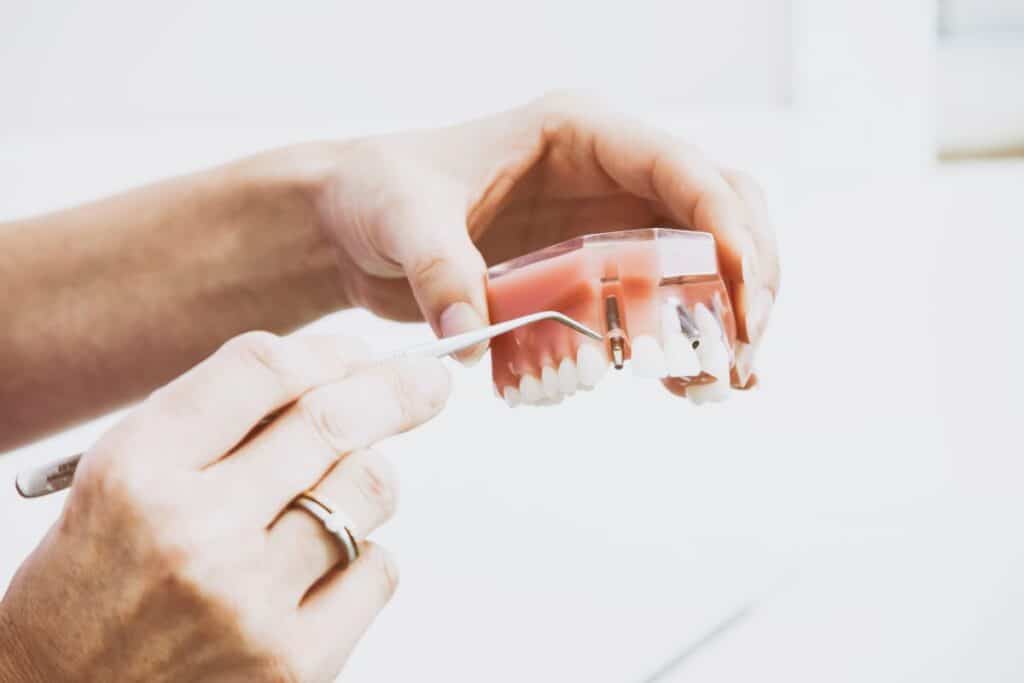
Dental implants are made of three parts. The crown or replacement tooth that you will see in your mouth, a connecter piece that is sometimes referred to as an abutment, and the base, which is a titanium screw.
The crown is a specially made crown that will attach to the implant base. It will be made of traditional crown materials, usually ceramic material that is designed to look like a natural tooth.
The abutment is used to attach the crown to the base structure. The base, which is usually a screw made of titanium, is placed into the jawbone. Once the bone has fused with the base, it provides a stable structure on which a crown may be attached.
Will my dental implants look natural?
Yes! To give the most natural look, the artificial teeth are made to complement the shape and color of your existing teeth. If you wish to whiten your teeth, you must do this before choosing the shade of the artificial tooth that will be used on the implant.
Can dental implants be whitened?
No, porcelain teeth cannot be bleached or whitened. If you wish to whiten your teeth, you must do this before deciding upon the color for the implant replacement tooth to ensure the best possible match.
Are dental implants safe?
Dentists have been using implants for a long time, and the technology has advanced a lot over the years. Just like any surgery, there are possible complications that can occur. Although unlikely, problems with an implant are usually minor and easily fixable. Implants typically have a success rate of about 95%. When problems arise, it is usually due to other factors, rather than the implant itself.
Are dental implants expensive?
Generally, an implant does not cost much more than a 3-tooth bridge. However, the long-term cost of having an implant versus a bridge is much lower, since a bridge is usually replaced every 7 to 15 years. With proper care, your implant will most likely never need to be replaced.
Are dental implants covered by Medicare, Medicaid, or medical insurance?
Dental implants usually fall under the cosmetic dentistry category. With that being said, if your dental insurance does not cover cosmetic procedures, if one of these types of procedures is necessary to improve or protect the overall functionality or health of your teeth, gums, and bone, it can easily become a covered procedure.
Generally, Medicaid and Medicare will not cover most dental services. Unfortunately, Medicaid often takes the view that only the least expensive treatment will be covered, rather than the best possible treatment.
The dental office staff can usually help you understand better what procedures are and are not covered.
Are dental implants considered cosmetic?
Dental implants are usually considered cosmetic because having an implant done restores the look of the mouth and is much nicer than seeing a gap in your smile from a missing tooth. Especially in the front teeth.
Are dental implants tax-deductible?
The Internal Revenue Service does allow taxpayers some relief by making some medical expenses partly tax-deductible. To take advantage of this tax deduction, you will need to find out what counts as a medical/dental expense and how to claim it.
Share: